New Issue of ‘Conservation Notes’
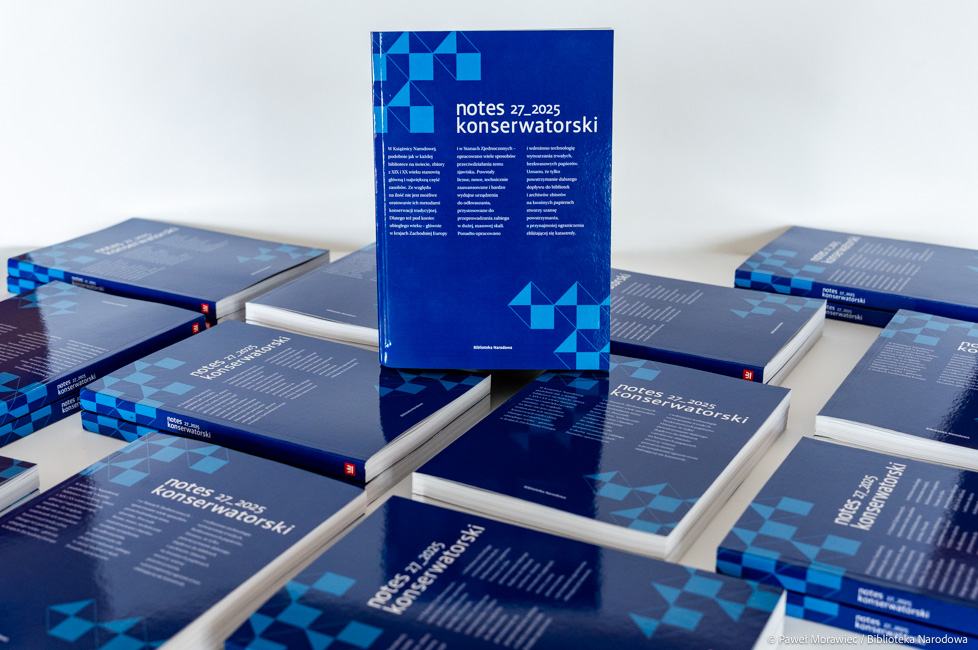
Conservation Notes (Notes Konserwatorski) presents articles on collection preservation policy as well as research and conservation, each preceded by an abstract in English. The texts are accompanied by numerous photographs. The journal is included on the Polish Ministry of Science and Higher Education’s list of scored academic journals, with a score of 40 points, and is also indexed in the international Scopus database.
The current 27th issue of Conservation Notes (Notes Konserwatorski) returns to the subject of the mass deacidification of 19th- and 20th-century collections. Władysław Sobucki presents the results of deacidification achieved at the National Library between 2005 and 2024, summarizing the past quarter century since the implementation of the Government’s Multiannual Programme for 2000–2008, “Acidic Paper: Mass Preservation of Endangered Polish Library and Archival Collections.”
In her article, Ewa Potrzebnicka traces the historical changes in approaches to heritage preservation, linked, among other things, to legislative changes. In this context, she draws particular attention to what she sees as the insufficient protection of the authenticity of written heritage monuments.
Ewa Sobiczewska continues the subject of Japanese kyokushi printing paper. This is the second part of an extensive study begun in last year’s issue of Notes Konserwatorski. Supplemented with an extensive bibliography, the article presents the technological details of the manufacture of this paper in Japan throughout the 19th century.
Diana Długosz-Jasińska has prepared a study of the pH measurements carried out in 2023 on manuscripts from the Fryderyk Chopin Museum in Warsaw. The comparison of results shows the changes occurring in paper substrates depending on the deacidifying agents used, and also provides data for planning future preservation measures. The article is also presented in full in English.
In two articles, Radosław Brzozowski and Izabela Zając discuss the technological aspects of historical photographic techniques: methods of developing silver images and photosensitive negative materials on glass supports. The structured knowledge contained in both texts facilitates the correct identification of objects requiring protection or conservation. The authors provide numerous references to relevant literature, as well as an extensive bibliography on the subject.
Katarzyna Ruta of the Elbląg Library presents the story of the rediscovery and incorporation into the library’s holdings of exceptional objects thematically connected with the region: a collection of biological specimens, including anatomical plates, prints, drawing boards, and lithographs by Friedrich Kaufmann.
Agata Lipińska and Joanna Ważyńska have prepared the annual review of the most interesting events, conferences, and meetings devoted to conservation, research, and the protection of historic heritage.
In January 2024, Józef Charytoniuk passed away – an artist, conservator, teacher, head of the conservation studio from 1982, and later head of the National Library’s Department of Library Collections Conservation. The artist is remembered by his friends and colleagues.
The print version of the journal is available from the online bookstore.
We encourage authors to submit their texts for the next issue of Conservation Notes (Notes Konserwatorski) by 30 May 2026. All information about the journal is available at notes.bn.org.pl.